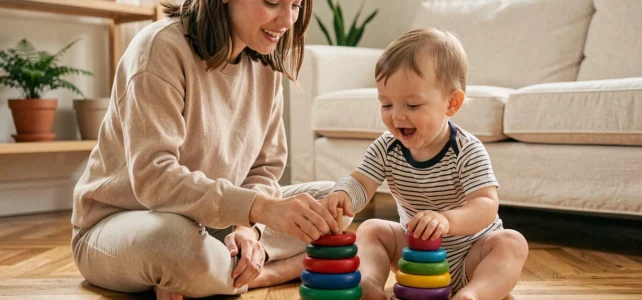
The awakening of a child is not just about accumulating activities. The quality of interactions, the sensory environment, and the regularity of temporal markers weigh more heavily than the volume of proposed stimuli. We regularly observe that parents overinvest in educational materials at the expense of what truly structures development: the predictability of the environment and the freedom of guided exploration.
Screens and children’s sleep: what the new recommendations change
The logic of a simple screen time limit is giving way to a contextual approach. The American Academy of Pediatrics now emphasizes the quality of content, that screens should not compete with sleep, physical activity, and family life, and the development of a personalized family media plan.
For children under 18 months, the recommendations remain significantly stricter than what most popular articles suggest. We recommend avoiding any screen time except for video calls with close relatives.
The strongest lever identified by recent summaries concerns sleep. No screens in the bedroom and stopping at least 30 to 60 minutes before bedtime: this simple rule has a measurable impact greater than strict daily quotas. Families that rely on concrete ideas for age-appropriate awakening activities, such as those listed on the website unptitairdefamille.com for children, have resources to replace evening screens with structured quiet times.
On the ground, pediatricians recommend shifting evening routines to non-digital activities: reading, drawing, coloring. This approach works better than the sole injunction of “less screen time” because it offers a concrete alternative to the child.

Free motor skills and exploration: structuring without directing
Allowing a child to explore on their own does not mean leaving them without a framework. Free motor skills require a secure environment where the child chooses their movements and postures. The adult observes, intervenes only in case of real danger, and resists the temptation to place the child in a position they have not yet acquired on their own.
This posture of active observation requires an adjustment of the space. On the floor, a firm mat and a few varied objects in texture and weight are sufficient. Recliners, walkers, and supportive seats hinder motor acquisition because they impose a posture that the child’s muscular system is not ready to support.
What markers to adapt the space daily
- Remove objects that impose prolonged passive postures (recliners used outside of transport, Bumbo seats) and prioritize time on the floor from the first weeks
- Vary exploration surfaces: mats, grass, hardwood, to enrich sensory feedback under hands and feet
- Place toys within reach without putting them directly in the child’s hands, to stimulate voluntary movement and hand-eye coordination
- Set up a low mirror corner that allows the child to observe their own movements, an underestimated tool for body awareness
We observe that children who benefit from this configuration develop their balance and confidence in movement more fluidly. The role of the parent shifts: less direct stimulation, more attentive presence.
Temporal markers and rituals: emotional security in daily life
A child who knows what will happen after bath time or after a nap has a foundation of emotional security that frees their capacity for exploration. Rituals are not rigidity. They provide a predictable framework within which the child can exercise their curiosity without anxiety.
Temporal markers benefit from being sensory rather than verbal for toddlers. A nursery rhyme before meals, a dim light signaling bedtime, a particular sound marking the end of play: these signals are understood long before language.
Building lasting rituals
The common trap is to multiply rituals to the point of turning the day into a rigid program. Three to four stable rituals per day are sufficient: waking up, meals, quiet time, bedtime. The rest of the day can remain flexible.
The opposite error also exists: total lack of regularity. A child exposed to erratic meal and sleep schedules expends considerable energy to adapt, energy that is no longer available for exploration and learning.

Child’s confidence and autonomy: valuing the process
Self-confidence is not decreed by repeated verbal encouragement. It is built when the child sees, through their own experience, that they are capable of doing something. Every stack of blocks that stands, every shoe put on alone, every staircase climbed without help produces a feedback more powerful than any compliment.
We recommend commenting on the action rather than judging it. “You stacked three blocks” informs the child about what they have accomplished. “Well done, that’s great” tells them nothing about their actual competence.
- Offer limited choices (two options, not five) so the child can exercise their decision-making ability without being overwhelmed
- Accept that tasks may take longer: pouring water, buttoning a coat, putting away a toy are exercises in autonomy, not time-wasters
- Do not immediately correct a non-dangerous mistake, as trial and error is the central mechanism of motor and cognitive learning
Autonomy progresses in irregular stages. An acquired skill may seem to disappear during a regression phase, which is actually a phase of reorganization. Waiting for the child to ask for help, rather than offering it spontaneously, preserves their momentum.
Ultimately, daily well-being rests on a few things: an adapted space, stable markers, unstructured free time, and an adult who observes before intervening. These four levers, combined consistently, cover the majority of a young child’s awakening needs.