
Waiting room at the doctor’s, train journey, rainy Sunday: you rummage through your bag, pull out a sheet of paper and a pen, and the question arises – “what do we do?”. These two objects are enough to start games that require much more than just the patience of children. They engage imagination, vocabulary, and the ability to invent rules, without any screens or expensive materials.
Blank sheet versus guided coloring: what the blank medium changes
It is often thought that giving a coloring page to a child stimulates their creativity. In practice, the result is more nuanced. Recent resources in artistic education show that a completely blank sheet placed next to a printed page changes behavior: the majority of children spontaneously shift from the guided medium to free drawing, inventing their own characters and scenes.
Coloring has its merits (fine motor skills, concentration), but it confines the child to an existing outline. The blank sheet, on the other hand, poses an open question. It is this absence of instruction that triggers imagination.
Specifically, when proposing a game with a sheet and a pen, you can start with a quick guided drawing (drawing a circle, a zigzag line), then ask the child to transform this outline into whatever they want. This transition from structure to freedom acts as a creative springboard, even for children who say “I can’t draw”.
A detailed analysis of these benefits can be found on the Le Chaudron Des Jeux website, which explores the link between paper-and-pencil games and creative development in children.
Paper-and-pencil games that develop different skills
Not all games on paper engage the same skills. Rather than listing ten activities, it’s better to choose three or four based on what you want to stimulate in the child.
The exquisite corpse revisited for younger kids
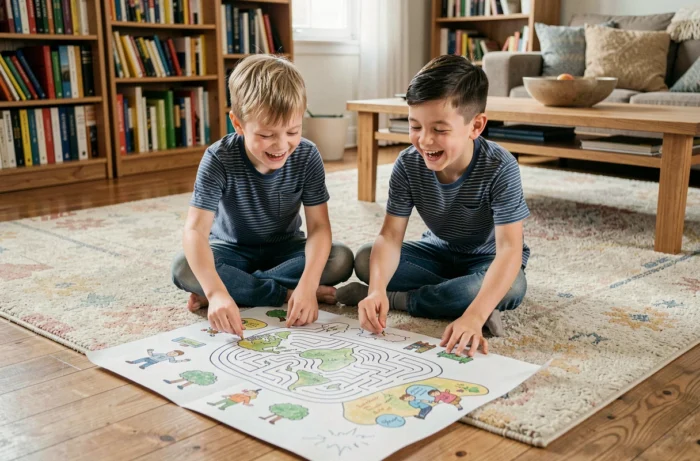
The classic principle (each player writes a word without seeing the others) works from the age of six or seven with a drawn variant. You fold the sheet into three. The first player draws a head, folds it, the next draws the torso, and the last draws the legs. The result, absurd and funny, teaches children to accept the unexpected in a creative process.
This folding mechanism forces relinquishing control. The child does not master the final result, and that is precisely what makes the exercise stimulating.
The dictionary game to enrich vocabulary
One player chooses a rare word from the dictionary and reads the definition aloud. The others invent a plausible false definition, then everyone votes. This game works on the ability to formulate plausible sentences, to play with language registers, and to argue.
For children aged eight to twelve, feedback varies on this point: some engage immediately, while others need two or three rounds to dare to invent. You can help by suggesting a word from the same family as the mystery word.
Constraint drawing: a driver of invention
You set a simple rule before drawing:
- Draw an animal using only triangles, which forces you to mentally decompose shapes
- Represent a place (kitchen, forest, planet) by drawing only five lines, which forces you to prioritize visual elements
- Start from an ink blot or random scribble and transform it into a character, which develops associative thinking
The constraint seems paradoxical, but it frees creativity by removing the vertigo of the blank page. The child no longer wonders what to draw; they seek how to solve a visual problem.
Reducing screen time with paper-and-pen games
Recent analyses on the impact of screens on children, particularly those from the Mustela Foundation, highlight the indirect effects of prolonged exposure: sleep disruption, reduced verbal interactions, and diminished creative abilities. Offering paper-and-pencil activities daily provides a concrete alternative, not a total replacement but a rebalancing of free time.
In practice, nothing is gained by banning screens without offering an appealing substitute. Paper games work as an alternative when presented as a challenge, not as a punishment. “Shall we have a drawing battle in five minutes?” sounds better than “put down your tablet”.
Integrating these games into family routine
The most effective moment is often when the child is already bored: late afternoon, waiting at a restaurant, coming back from school. Having a sheet and a pen in the bag (not a too-nice notebook that one hesitates to use) is enough to start a game.
Some guidelines to ensure it lasts:
- Alternate competitive games (tic-tac-toe, categories) and cooperative ones (exquisite corpse, collective drawing) to avoid boredom
- Allow the child to invent their own rules based on an existing game, which doubles the creative stimulation
- Keep the game sheets in a folder or box, so the child can see their productions accumulate and measure their progress
Creative confidence builds through accumulation. A child who fills dozens of sheets eventually dares to create drawings and stories they would never have attempted at first. The volume of production matters as much as the quality of each drawing.
The role of parents is not to guide every stroke but to participate. Playing together, accepting to produce a failed drawing, laughing at an absurd exquisite corpse: this is what gives the child permission to create without fear of judgment. A sheet, a pen, and an adult who plays along – the rest comes naturally.