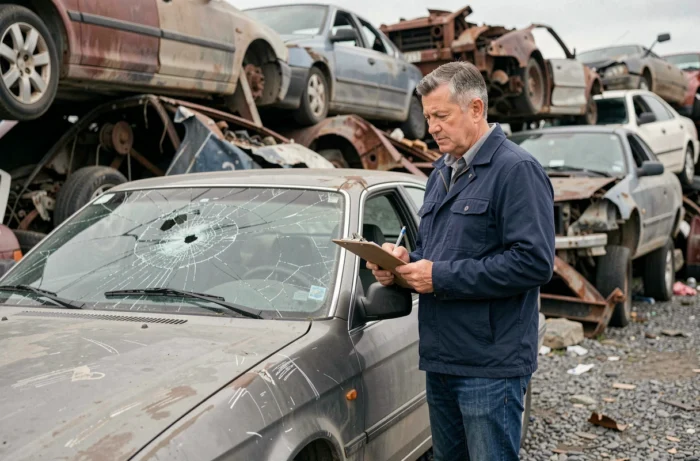
A car that no longer passes its roadworthiness test or has a blown engine takes up space and loses value every month. Handing it over to an auto salvage yard (an authorized ELV treatment facility) lets you dispose of it legally, sometimes in exchange for payment.
The price offered depends on the vehicle’s condition, the weight of its metal and demand for its spare parts. Before signing, it’s worth comparing the net amount with other resale options.
Repairable car or scrap vehicle: the calculation no one considers
When a mechanic quotes more for repairs than the vehicle is worth, the instinctive reaction is to think, “Off to the scrapyard.” Sometimes, that reaction means losing money.
A vehicle that still runs, even if it has faults, retains market value for private buyers and vehicle-buying professionals. The difference in price can be significant compared with what an ELV treatment facility would offer for the same car.
Take a common example: a twelve-year-old city car with a working engine and a worn clutch. An ELV treatment facility mainly assesses the weight of its metals and the parts that can be resold. A vehicle-buying professional, on the other hand, looks at its residual market value and its resale potential after minor repairs.
To better understand how auto salvage yards buy back cars, you need to distinguish between two situations. A vehicle declared economically irreparable has no other legal destination than an ELV treatment facility. An aging vehicle or one with a partial breakdown still has other options.
Auto salvage yard buyback prices: what makes an offer go up or down
There is no regulated buyback rate. Each authorized ELV treatment facility sets its own prices, and many offer no payment at all. The law only requires free collection of a complete vehicle intended for destruction.
Wondering what prompts a facility to pay rather than simply accept the vehicle? Three main factors come into play:
- The weight of ferrous and non-ferrous metals: steel, aluminum and copper found in the bodywork, engine and wiring harness have a fluctuating market price. The heavier the vehicle, the more valuable the recoverable metals.
- Demand for used spare parts: a model that is still common on the road generates parts sales. A working engine, gearbox or control unit will fetch far more than its scrap-metal value.
- The vehicle’s overall condition and completeness: a vehicle that arrives without wheels, a battery or a catalytic converter is worth considerably less. Facilities also check that the catalytic converter is present, as it contains precious metals in demand on the recycling market.
In practice, buyback offers range from zero (free collection only) to a few hundred euros for a complete vehicle with sought-after parts or metals.
Net comparison: auto salvage yard, vehicle-buying professional or private sale
Choosing the right sales channel depends on the vehicle’s actual condition and how much time you have. Here’s a practical guide.
| Channel | Vehicle profile | Typical net amount | Requirements |
|---|---|---|---|
| Authorized ELV treatment facility | Scrap vehicle, declared ELV, incomplete vehicle | Free to a few hundred euros | Collection often included, simplified paperwork |
| Vehicle-buying professional | Running or repairable vehicle | More than an ELV facility (depending on residual value) | Roadworthiness test may be required |
| Private sale | Running vehicle with a valid roadworthiness test | Highest if you’re patient | Listings, viewings, negotiation, roadworthiness test required |
A private sale brings in more, but requires a valid roadworthiness test and time to handle inquiries. A vehicle-buying professional offers a compromise: a quick transaction at an intermediate price. An ELV treatment facility remains the only legal option when a vehicle has been declared irreparable.
Transport and hidden costs
An authorized ELV treatment facility is required to collect a complete vehicle free of charge. This matters when calculating your net proceeds. If you sell to a distant private buyer or a professional who doesn’t come to you, towing or flatbed transport costs will eat into your profit.
Always calculate the net amount after transport costs before comparing offers. A buyback offer of a few hundred euros with collection included may be better than a higher sale price that requires paid towing.
Administrative steps for transferring a vehicle to an ELV treatment facility
The process is regulated and protects the seller against any fraudulent use of the vehicle after it has been transferred.
- Fill out the transfer form (the relevant Cerfa form) with the ELV treatment facility. The professional then handles the declaration to the authorities.
- Hand over the vehicle registration document, crossed out and marked “sold on” or “transferred on,” followed by the date and your signature.
- Obtain the certificate of destruction issued by the ELV treatment facility. This document proves that the vehicle was handled through the legal system and releases you from any future liability.
- Keep the certificate of destruction indefinitely: it may be requested in the event of a late traffic fine or an administrative dispute.
One important point: only an ELV treatment facility authorized by the prefecture can issue a valid certificate of destruction. An unauthorized scrap dealer cannot cancel the vehicle’s registration, which means the vehicle remains legally registered in your name, with all the consequences that entails (fines, taxes).
Check the facility’s authorization
You can find the list of authorized ELV treatment facilities on the Ministry for Ecological Transition’s website or at the prefecture. Before handing over a vehicle, ask for the facility’s authorization number and verify it. This takes just a few minutes and can save you months of administrative hassle.
Having an auto salvage yard buy back your car is best suited to end-of-life vehicles or those damaged beyond economically viable repair. If your vehicle still runs, comparing offers from vehicle-buying professionals or trying a private sale is the most reliable way to get a fair price. In every case, the certificate of destruction issued by an authorized ELV treatment facility is the only document that permanently releases you from responsibility for your old vehicle.