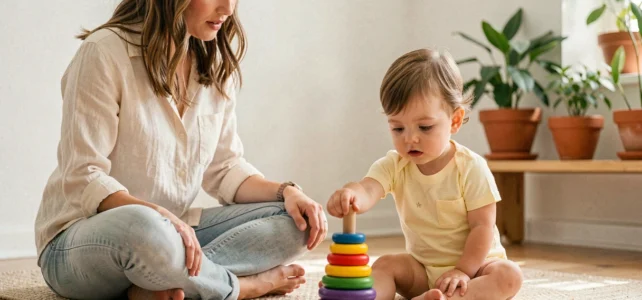
A child who spills his bowl of applesauce on the table is not clumsy; he is testing gravity. This kind of scene, repeated several times a day, forms the very foundation of awakening. Supporting a child’s well-being and development on a daily basis requires neither expensive materials nor structured programs: every micro-moment of the day can be transformed into a learning opportunity, provided one knows what to observe and when to intervene.
Transforming bath time and meals into sensory awakening activities
It is often thought that a dedicated time slot is needed to stimulate a toddler. In practice, the most mundane situations offer a rich ground. During bath time, pouring water from one cup to another engages hand-eye coordination and introduces concepts of volume.
At mealtime, naming the textures and colors of the food enriches language well before the first sentences. We describe what we are doing: “I am cutting the banana; it is soft; can you smell it?” This natural commentary, without forcing a response, nurtures verbal understanding.
To explore the entire child universe of Maman Chic, one quickly realizes that everyday accessories (wooden spoons, stacking cups, fabrics of various textures) are more than sufficient to create a stimulating environment without multiplying toys.
Bath time also remains a privileged moment to observe motor skills: a baby splashing in the water is working on muscle tone. Commenting on his actions (“you are splashing a lot!”) strengthens the connection between action and language.
Morning and bedtime rituals: anchors for emotional regulation
Parenting guides often present routines as simple organizational tools. Their function goes further. A stable ritual helps the child regulate their emotions, not just structure their day.
In practical terms, a morning ritual can consist of three gestures: opening the shutters together, naming the weather visible through the window, choosing an outfit. This sequence, repeated every day, gives the child a sense of control over their environment. They anticipate, they participate, they gain autonomy.
Signs of fatigue as a compass
The bedtime ritual works better when we learn to read signs of fatigue rather than just following the clock. A child rubbing their eyes, looking away, or becoming irritable for no apparent reason sends clear signals.
Recognizing these signs avoids phases of overstimulation that make falling asleep more difficult. We dim the lights, slow down our speech, and transition to a calm activity (browsing a picture book, singing a gentle lullaby). The transition is smooth rather than abrupt.
Tummy time and free movement: what works by age
Tummy time is a recommendation regularly emphasized by pediatricians. The basic rule: always awake and under adult supervision. This time strengthens the neck, back, and shoulder muscles and limits the effects of prolonged back positioning.
In practice, we start with a few minutes after a diaper change, on a firm mat. A small mirror placed in front of the baby’s face captures their attention and encourages them to lift their head. Feedback varies on the ideal duration depending on age, but observation remains the best guide: if the child protests, we stop and try again later.
Free movement after the first months
When the child begins to roll over on their own, free movement takes over. We set up a clear and safe space on the floor where they can explore at their own pace.
- Avoid supportive devices (bouncers, walkers) that limit natural movements and delay certain motor skills
- Offer objects of various sizes and weights within reach to encourage grasping
- Allow the child to experiment with postural transitions (rolling, crawling, sitting) without placing them in a position they have not reached on their own
Respecting each child’s own rhythm remains the guiding principle. A baby who crawls for a long time before walking develops solid coordination and spatial awareness.
Music, language, and listening games without screens
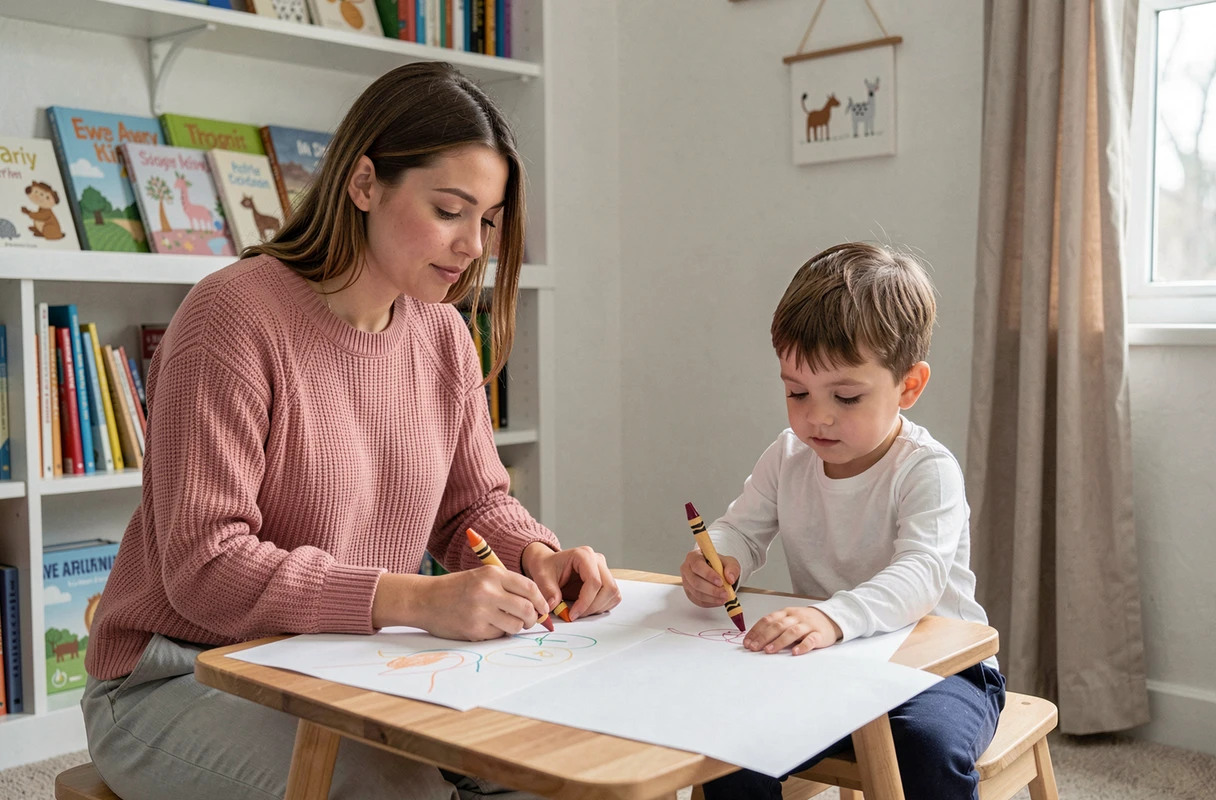
Music impacts language development long before the child utters their first sentences. Singing during car rides or tapping a rhythm on the table during snack time is enough to stimulate active listening.
An effective and material-free game: sound hunting. We stop, listen, and name. “Do you hear the bird? And the car?” This type of exercise sharpens auditory discrimination, a skill that directly prepares for the learning of articulated language.
Talking with the child, not to the child
The classic trap is to comment in a monologue. To stimulate language, we leave silences after a question, even if the child does not yet respond verbally. A babble or a hand gesture is already a response that we can validate by rephrasing.
- Use short and concrete sentences rather than abstract instructions (“give me the red spoon” rather than “put away your things”)
- Repeat new words in different contexts to anchor vocabulary
- Read picture books while pointing to the illustrations, waiting for the child to point in turn
This asymmetrical dialogue, where the adult adjusts their level without infantilizing, builds the foundations of verbal autonomy.
A child’s awakening cannot be scheduled like a private lesson. We accompany them by slowing down, observing what captures their attention, and transforming everyday gestures into learning opportunities. Bath time, mealtime, a trip, an open window onto the street: every ordinary moment holds a potential for learning that the child seizes at their own pace.