
The height of a snack counter is not just a single number applicable to all kitchens. It depends on a precise gap between the seat and the countertop, the users’ body types, and the intended use. Measuring this gap helps avoid the most common mistakes: knees getting stuck, feet dangling, or uncomfortable posture during breakfast.
Snack counter, bar, and table height: a comparison of standards
Three configurations coexist in today’s kitchens, each with its height range and associated stool type. Confusing them leads to inappropriate choices.
| Type of surface | Countertop height | Recommended seat height | Seat/countertop gap |
|---|---|---|---|
| Classic table | 74-76 cm | 45-48 cm | 26-30 cm |
| Snack counter | 85-95 cm | 60-65 cm | 25-30 cm |
| Bar / high table | 105-120 cm | 75-80 cm | 25-30 cm |
The constant in this table is the right column. Regardless of the type of surface, the gap between the seat and the countertop remains 25 to 30 cm. This measurement determines comfort, not the absolute height of the countertop taken in isolation.
A snack counter thus serves as an intermediate solution between the dining table and the elevated bar. Its range of 85 to 95 cm allows for comfortable seating on a mid-height stool, without the perch-like feeling caused by a high table. By consulting the information from La Cigale et la Fourchette, you can find this logic of intermediate height suitable for quick meals as well as moments of conviviality.

Seat-counter gap: the ergonomic data to remember
Setting the countertop height without considering the stool is a common mistake. Buying a snack counter at 90 cm and then choosing stools with a 75 cm seat results in a gap of only 15 cm. Thighs end up compressed against the underside of the countertop.
The ergonomic rule is simple: the seat should be 25 to 30 cm below the countertop. This calculation works for all standard adult body types. For a countertop at 90 cm, the ideal stool has a seat height between 60 and 65 cm.
Several stool manufacturers offer adjustable height models, which solves the problem when the countertop height is already fixed. However, if you are starting from scratch, it is better to first choose the countertop height that corresponds to your use, then select the stools accordingly.
Adapting height to body type
Recent kitchen ergonomics recommendations no longer settle for a fixed standard. They suggest a personalized calculation based on elbow position. The principle: when standing, arms at your sides, the countertop ideally comes 10 to 15 cm below the elbow.
This method, used by several kitchen designers for classic countertops, also applies to hybrid snack counters (those that serve as both a preparation area and a dining corner). If you are around 170 cm tall, a 90 cm countertop will be suitable. For a taller person, a 95 cm countertop will be more appropriate.
Snack counter on a kitchen island: specific constraints
The central island is the most common location for a snack counter in open kitchens. It introduces a constraint that wall installations do not have: managing two levels on the same piece of furniture.
An island that combines a preparation area and a snack counter often features a drop. The kitchen side countertop remains at standard height (around 85-90 cm), while the snack side facing the living area can be raised or lowered. Three options are available:
- The snack counter at the same level as the countertop (85-90 cm): the simplest solution, allowing the entire surface to be used for both preparation and meals, with 60 cm seat stools
- The raised snack counter with a drop (100-110 cm): creates a visual separation between the kitchen and living area, hides clutter on the preparation side, but requires taller bar-type stools
- The lowered snack counter (75-80 cm): accessible with standard chairs, suitable for families with children, but reduces the useful work surface on the kitchen side
The choice primarily depends on the dominant use. A snack counter used daily for family meals benefits from remaining at an intermediate height (90 cm). A counter oriented towards appetizers or occasional use can go up to 105-110 cm without issue.
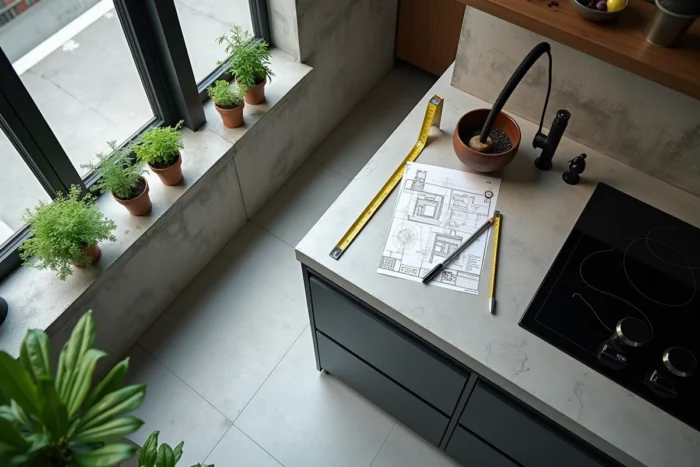
Width and overhang of the snack counter: often neglected dimensions
Height alone does not guarantee comfort. The depth of the overhang, that is, the part of the countertop that extends beyond the furniture and under which legs can slide, plays a direct role in seated posture.
A minimum overhang of 25 to 30 cm is necessary to comfortably accommodate the knees. Below this, the user is forced to sit at an angle or pull the stool back, which negates the sought-after space savings.
The useful width per person is around 60 cm. Therefore, two side-by-side seats require a snack counter at least 120 cm long. These dimensions are rarely mentioned in height guides, even though they condition both comfort and the vertical position of the countertop.
Countertop thickness and support
A significant overhang without proper support creates a lever effect on the countertop. Overhangs greater than 30 cm require support brackets, a support leg, or a reinforced cantilever structure. The thickness of the countertop also plays a role: a countertop that is too thin bends under the weight of resting forearms during prolonged support.
Solid materials (solid wood, natural stone, quartz) better support overhangs than thin laminated panels. If the budget leads to a particle board panel, sufficient thickness and a metal reinforcement under the overhang prevent gradual sagging.
Dimensioning a snack counter relies on three combined measurements: the height of the countertop, the gap with the stool seat, and the depth of the overhang. Fixing one without checking the other two results in an unstable outcome. The range of 90 to 95 cm remains the most versatile for daily use, provided that stools with a seat height between 60 and 65 cm are paired.