The fashion trends of the season are no longer just a list of colors or cuts spotted on the runways. Behind each piece that makes its way into wardrobes, underlying logics now play a direct role: European textile regulations, the rise of second-hand, and the return of artisanal know-how. Understanding these mechanisms allows for sustainable clothing choices, without blindly following every micro-trend.
Digital Product Passport and textile traceability: the game-changing framework
The European regulation on the eco-design of sustainable products (ESPR) has introduced the Digital Product Passport (DPP) for the textile sector. Each garment will need to include 49 standardized pieces of information covering its manufacturing, materials, and environmental performance.
The first obligations target spring-summer 2028 collections, with a ramp-up between late 2028 and mid-2029. This timeline means that brands are already designing their collections with these traceability constraints in mind.
For buyers, the consequence is concrete: the sustainability of a garment will become verifiable, rather than just declarative. A QR code or NFC chip will provide access to the origin of the fibers, the chemical treatments applied, and the assembly location. Choosing a trendy piece this season while already checking the brand’s transparency on these points is anticipating a standard that will become mandatory.
Details on recent style movements are regularly decoded on the fashion page of 11 Le Magazine, which closely follows the evolution of clothing codes season after season.

Anti-fast fashion law in France: a bonus-malus on clothing prices
France is the first country to legislate specifically against ultra-fast fashion. The bill adopted by Parliament provides for a bonus-malus system directly linked to the price of items. Brands that renew their collections at an excessive rate will see their products subjected to a malus, while those committed to reasoned production will benefit from a bonus.
This mechanism alters the economic equation of the wardrobe. Items from fast fashion could see their prices rise, making the choice of clothing designed to last several seasons even more relevant.
What this changes for daily style
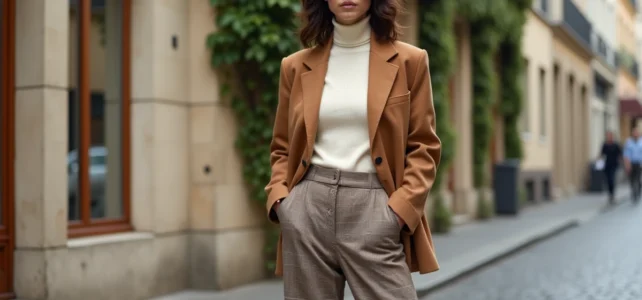
Investing in quality basics (a structured wide-leg pant, a flowy dress, a well-cut jean) becomes both an economic and stylistic reflex. The underlying trend no longer encourages the accumulation of pieces, but rather building a coherent wardrobe around a few strong silhouettes.
- A wide-leg pant with a defined waist can be worn from the office to the weekend and transitions effortlessly through the seasons.
- A long, flowy dress, inspired by the poetcore trend seen on the Milan and Paris runways, works solo or layered over a light sweater in mid-season.
- A coordinated set (matching jacket and pants or skirt) replaces multiple outfits and simplifies morning choices.
Lace, upcycling, and artisanal know-how: the materials defining the season
Lace is making a marked return in contemporary fashion, driven by a dual movement: a taste for visible textures and the valorization of craftsmanship. Several houses are blending lace with upcycling, reusing stocks of old fabrics to create unique pieces.
This is not just a runway effect. Textile craftsmanship is experiencing a measurable resurgence of interest, with trade shows like Bijorhca scheduling dedicated spaces for creators working with materials by hand this fall.
Colors and materials to remember this season
Palettes oscillate between intensity and natural tones. Orange, pink, yellow, olive green, sky blue: vibrant colors assert themselves on dresses and accessories. Meanwhile, neutral shades (beige, ecru, off-white) remain reliable choices for structuring an outfit.
In terms of materials, linen, thick cotton, and blends made from recycled fibers are gaining ground. The choice of material weighs as heavily as that of cut in the longevity of a piece. A fabric that pills after three washes cannot claim the status of a sustainable trend.
Fashion trends on TikTok and Pinterest: decoding signals before purchase
The annual Pinterest Predicts report, based on the analysis of user searches, now serves as a barometer to anticipate which pieces will make an impact. Brands and independent designers use it to calibrate their collections.
On TikTok, micro-trends appear and disappear within weeks. The trap would be to confuse virality with stylistic relevance. A piece seen millions of times on a social network does not guarantee its quality or adaptability to a real wardrobe.
Filtering fashion trends for a personal style
Three criteria help distinguish a useful trend from a fleeting fashion effect:
- Does the piece combine with at least three outfits already present in the wardrobe? If the answer is no, the risk of buying it to wear only once is high.
- Are the cut and material suitable for the body type and lifestyle? A structured wide-leg pant suits most silhouettes, while an asymmetrical crop top suits much less.
- Does the brand provide verifiable information about the product’s origin? With the upcoming arrival of the DPP, opacity regarding manufacturing becomes a warning signal.
Adopting the trends of the season does not mean renewing the entirety of one’s wardrobe. The European and French regulatory framework encourages more thoughtful purchases, and the most sought-after pieces this season (flowy dress, wide-leg pant, coordinated sets, artisanal textures) share a common point: they are designed to remain wearable well beyond a single season.