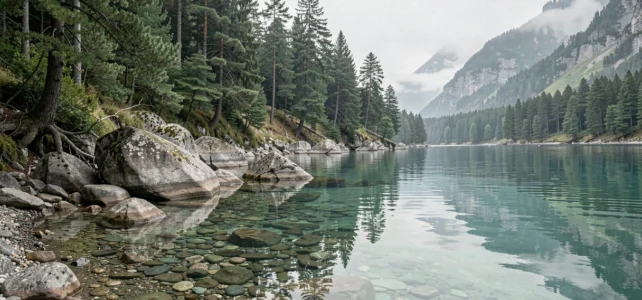
The Bourget Lake is not just about its supervised beaches and piers in Aix-les-Bains. Its west bank, backed by the cliffs of Mont du Chat, is home to pebble coves that are not served by any road. To access them, one must take to the water or follow steep trails, which keeps them free from excessive crowds.
Navigation Regulations Near the Coves of Bourget Lake
Before planning a trip to these coves, it is essential to understand the framework governing navigation on the lake. The Particular Police Regulation for Navigation (RPPN) imposes a speed limit of 5 km/h in the coastal strip of 300 meters. This area corresponds precisely to where most of the wild coves on the west bank are located.
The reed beds, these belts of reeds that line some natural coves, are classified as protected habitats. Approaching them is prohibited. In practical terms, this means that one cannot anchor just anywhere, even in a seemingly deserted cove. It is necessary to identify the reed areas and maintain a sufficient distance.
Every boat operating on the lake must be registered and have a sticker issued by the Savoie DDT. These regulations are not trivial: they condition access to the wild coves of Bourget Lake and should be checked before each season.
Recent rules also strengthen the management of the coastline in a broader sense: smoking is prohibited on the beaches, noise pollution is limited, and there are regulations on alcohol consumption and waste disposal. Although these measures primarily target developed beaches, they reflect a clear trend towards regulating usage across all shores.

West Bank of Bourget Lake: Why These Coves Remain Preserved
You may wonder why some coves maintain their wild appearance while the lake has been frequented for decades? The answer lies in geography. The west bank is dominated by the cliffs of Mont du Chat, which plunge almost vertically into the waters. No road runs along this stretch of coastline.
This natural configuration acts as a filter. The coves accessible only by boat or via technical trails receive only a fraction of the visitors flocking to the east bank. Pebbles replace sand, pines cling to the rocky walls, and the waters shift from turquoise to emerald depending on the depth.
The contrast with the Aix-les-Bains shore is striking. On one side, equipped beaches, restaurants, and water rentals. On the other, a silence punctuated by the lapping of water against the rocks. It is this geographical imbalance that gives these coves their value for lovers of preserved nature.
Geology and Water Color
The remarkable hue of the waters near the coves is explained by the limestone nature of the cliffs. The light-reflecting particles of light-colored rock suspended in the water produce the characteristic turquoise shades of alpine lakes. The faster the depth increases (as is the case at the foot of the cliffs), the more pronounced the color gradient.
Accessing the Wild Coves by Foot or by Boat
There are two options, and they are not equivalent.
By Water
This is the most direct means. From the Grand Port of Aix-les-Bains or Le Bourget-du-Lac, one can reach the coves on the west bank while respecting the speed limit in the coastal strip. A few points to keep in mind:
- Check the registration and sticker of the boat before departure, or risk a fine
- Identify the reed areas on a nautical map of the lake to avoid protected habitats
- Plan to anchor on a bed of pebbles or rock, ensuring that the anchor holds well before getting into the water
- Take your waste with you: there are no bins or facilities in these isolated coves
By Trails
Some coves are accessible from paths that descend from Mont du Chat or Bourdeau. These trails are steep, sometimes poorly marked, and require suitable footwear. The descent can take less than an hour, but the ascent under the summer sun is much more demanding.
A well-known trail along the lake has recently reopened to walkers, but several forested areas around the lake have been subject to access restrictions during drought episodes. Before leaving, check the current prefectural orders: a trail open in June may be closed in August.
Preserving the Wild Coves: Concrete Actions for Visitors
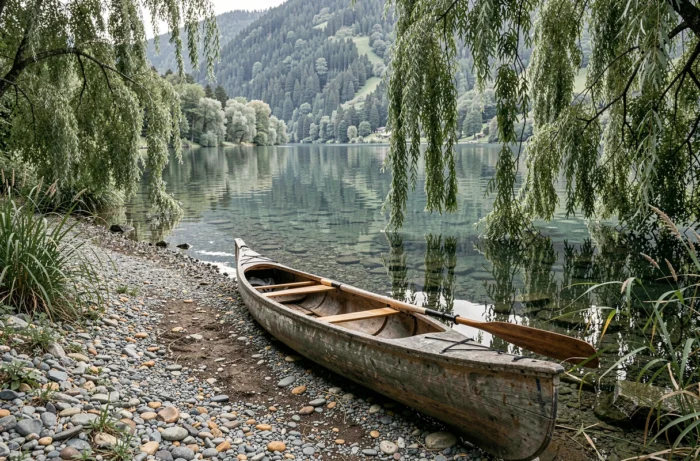
The visitation of these coves is increasing as social media brings them to light. The paradox is well-known: the more a wild place is talked about, the less wild it remains. Some practices distinguish a visitor who preserves the site from one who harms it.
- Leave no trace: no cigarette butts, no organic waste (fruit peels take months to decompose), no fires
- Respect aquatic wildlife by avoiding turning over submerged stones, which shelter larvae and invertebrates
- Limit noise volume: the cliffs create an amphitheater effect that amplifies even the slightest sound, including portable speakers
- Prefer visits on weekdays or early in the morning, when the pressure on the coves is minimal
Bourget Lake is the largest natural lake in France. Its wild shore constitutes an ecological heritage that regulations protect, but individual behaviors either preserve or degrade it on a daily basis.
The coves on the west bank do not appear in any official tourist brochures. They exist because geography isolates them and navigation rules limit motorized access. As long as these two conditions hold, these fragments of alpine nature will remain accessible to those who are willing to slow down to reach them.