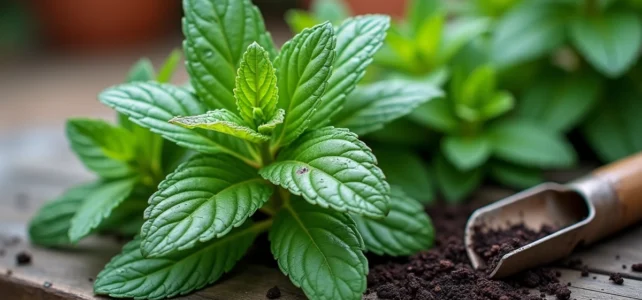
When mint leaves turn brown and then black, the common reflex is to look for a fungicide treatment. However, the problem often lies upstream, in the way the plant is watered and ventilated. Identifying the exact mechanism of blackening allows for action on the right cause and avoids unnecessary interventions.
Quick diagnosis of blackened mint leaves: table of causes
Before taking any action, distinguishing the causes helps avoid inappropriate treatment. The table below summarizes the three most common scenarios, their visual signs, and the main triggering factor.
| Type of blackening | Visual appearance | Location on the plant | Main cause |
|---|---|---|---|
| Excess water and root rot | Soft leaves, gradual blackening from the base upwards | Lower leaves first | Waterlogged substrate, insufficient drainage |
| Sunburn | Dry brown spots, cracking edges | Leaves exposed to direct sunlight (often the top) | Prolonged exposure on wet foliage |
| Fungal disease (rust, Septoria) | Small black or orange spots, sometimes surrounded by a halo | Random distribution, often poorly ventilated inner leaves | Stagnant humidity + lack of air circulation |
This visual diagnosis guides the response. Blackening that progresses from the bottom to the top points to a root problem. Localized spots on the upper leaves suggest a burn or a fungus. When facing a disease of blackened mint leaves, this distinction conditions the entire follow-up.
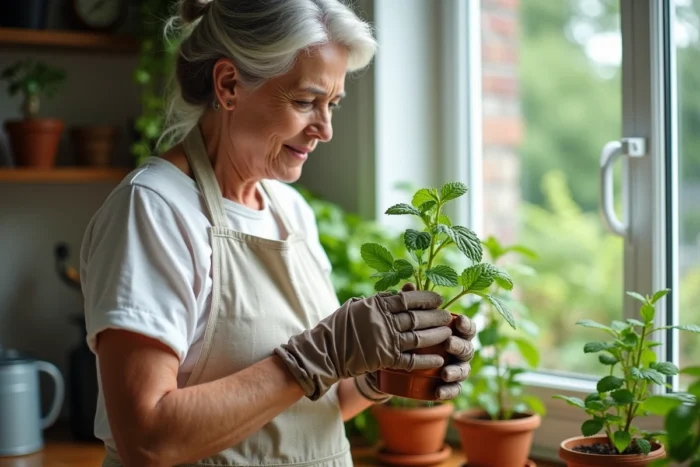
Watering at the base and weight test: the correction that changes everything
The majority of cases of blackening mint leaves in pots stem from excess water combined with overhead watering. Wetting the foliage creates a moisture film that promotes both sunburn (magnifying effect) and the development of fungi.
The pot test one hour after watering
A simple protocol allows you to check if the substrate retains too much water. Just lift the pot one hour after watering and judge its weight. An abnormally heavy pot indicates a waterlogged substrate, where the roots stagnate and begin to rot.
Water should drain freely through the drainage holes in the seconds following watering. If it takes more than a minute to appear, the substrate is too compact or the holes are blocked.
- Always water at the base, never on the foliage, to limit residual moisture on the leaves
- Check that the saucer does not contain stagnant water after about fifteen minutes
- In pots, prefer a draining substrate (mix of potting soil and coarse sand or perlite) rather than pure potting soil that retains too much water
- In the ground, avoid areas where water runs off and stagnates after rain
This change in habit, switching from watering on the foliage to watering at the base, is sufficient in many cases to stop the progression of blackening without any treatment products.
Ventilation around mint plants: an underestimated lever
Mint is a vigorous plant that produces dense foliage. This density becomes a problem when air no longer circulates between the stems. Humidity gets trapped, local temperature rises, and fungal spores find ideal conditions.
Thinning to aerate
Feedback shows that improving ventilation around the pots significantly reduces blackened areas, without resorting to treatment. In practice, this means spacing the pots, not pressing the mint against a wall, and removing the densest stems from the center of the plant.
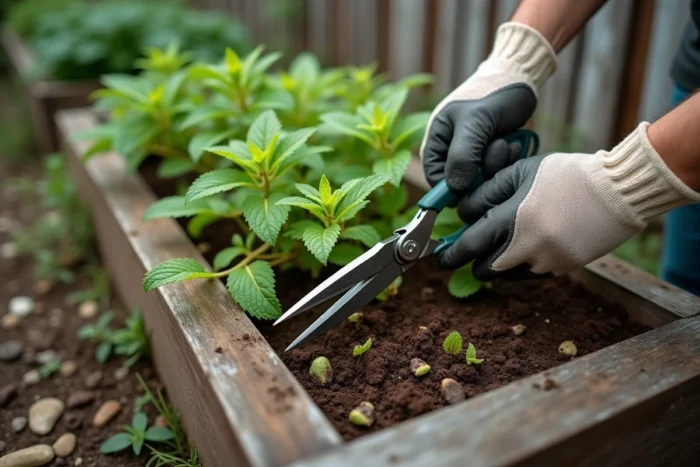
On a plant in the ground, thinning the inner stems frees up space. Air circulates, the foliage dries faster after rain or watering, and fungi lose their preferred habitat.
When sooty mold masks an aphid problem
Some blackenings do not come from watering or a direct fungus. Sooty mold is a black deposit that develops on the honeydew secreted by aphids. It does not parasitize the leaf itself but covers it with a dark layer that blocks photosynthesis.
Treating sooty mold without eliminating the aphids amounts to cleaning a symptom that will reappear in a few days. Inspecting the stems and the underside of the leaves allows you to spot colonies of black aphids, often clustered on young shoots.
- A jet of water on the colonies dislodges most of the aphids without insecticide
- Diluted black soap (a few tablespoons in a liter of water) applied as a fine spray suffocates the remaining insects
- Encouraging the presence of ladybugs and hoverflies in the garden naturally reduces aphid populations
Blackened leaves after harvest: enzymatic oxidation and preservation
Blackening is not only a concern for plants in the ground or in pots. Freshly cut mint leaves sometimes turn black within hours. This phenomenon results from enzymatic oxidation triggered by polyphenol oxidase, an enzyme released as soon as the leaf cells are damaged by cutting, crushing, or folding.
The phenolic compounds in the leaf are then transformed into brown, then black quinones. The same mechanism causes a cut apple to brown.
To slow down this reaction, two gestures are sufficient. Handle the leaves as little as possible after picking, avoiding stacking or compressing them. Then place them in a glass of water at room temperature, with stems submerged and leaves exposed to air, rather than in a plastic bag in the refrigerator where condensation speeds up blackening.
The cold of the refrigerator can itself cause necrosis on fragile leaves. If cool storage is necessary, wrapping the leaves in slightly damp absorbent paper limits direct contact with the cold and excess moisture.
The blackening of mint leaves rarely stems from a single cause. Drainage, ventilation, aphid management, and post-harvest handling form a set of parameters to be adjusted simultaneously. Correcting watering and aeration is sufficient in most situations to stop the progression without resorting to any products.