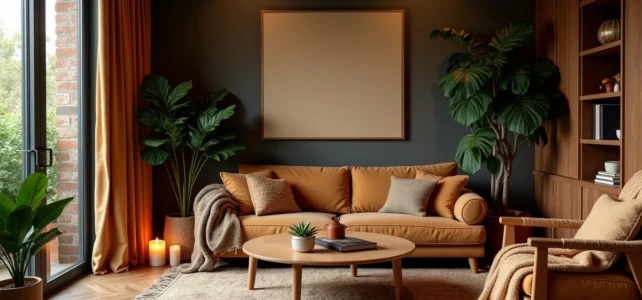
Transforming a house into a warm cocoon involves balancing a cozy atmosphere with housing realities: budget, space, insulation, maintenance. The following ten tips focus on concrete actions, each evaluated from the perspective of visual effect versus practical constraint.
1. Dark wood furniture to anchor the atmosphere
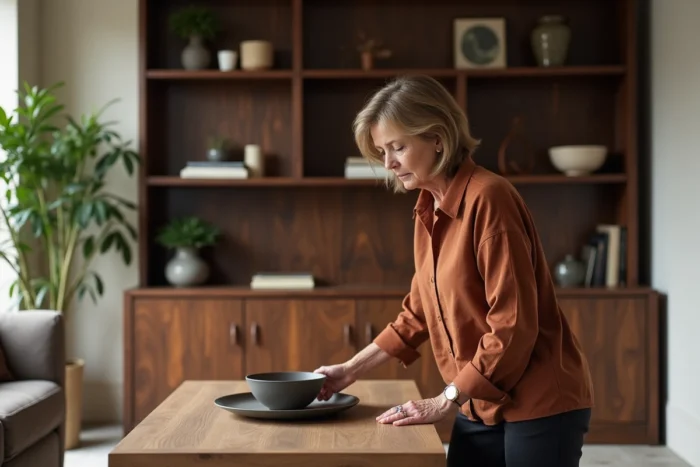
The 2026 decor trends reintroduce dark wood as a counterpoint to the light Scandinavian style that has dominated for a decade. A walnut sideboard or a stained oak table immediately adds depth to a room, even a small one.
However, dark wood absorbs light. In a north-facing living room or a bedroom without a large window, it is necessary to compensate with light-colored walls or a mirror opposite the furniture. Dark wood works best when paired with reflective surfaces rather than isolated in an already dark space.
In terms of maintenance, matte finishes show fingerprints more than light wood. A satin varnish minimizes this issue without sacrificing the desired raw look.
2. Layered lighting rather than a single source
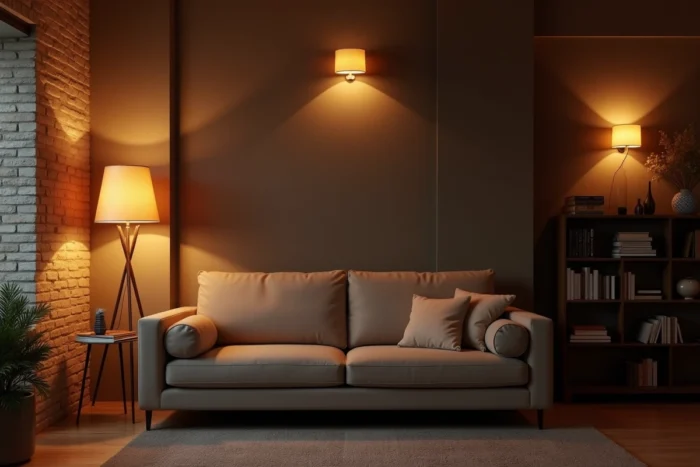
A central ceiling light does not create ambiance; it illuminates. To achieve a warm interior, at least three levels must be layered: ambient light (floor lamp, string lights), functional light (reading lamp, desk lamp), and accent light (candle, directional spotlight).
Each source should be able to turn on independently. A dimmer on the ceiling light costs a few euros and radically changes the perception of a space in the evening. Three distinct sources are enough to transition from flat lighting to a cozy atmosphere.
Many decor articles recommend candles, rightly so, but they pose a real constraint: the smoke detectors required in French homes easily trigger in small rooms. Prefer candles in the living room or dining room, not in a closed bedroom. To explore decor choices that intersect comfort and habitat, check out the house on La Règle du Je.
3. Heavy textiles for real thermal comfort

A thin polyester throw gives a visual cocooning effect but does not retain heat. For textiles to contribute to thermal comfort as well as decoration, the weight matters. Wool, thick linen, and brushed cotton insulate better than lightweight synthetic fibers.
Also consider thick curtains. Lined curtains significantly reduce heat loss through windows in winter, a factor often overlooked when discussing a warm cocoon.
4. Reading or relaxation nook with space constraints
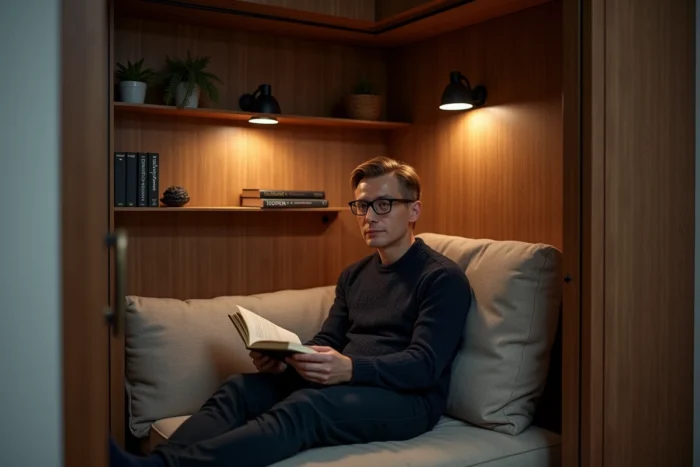
Setting up a relaxation nook does not require a dedicated room. An armchair, a reading lamp, and a wall shelf take up less than two square meters. The principle: a dedicated nook is defined by its own lighting, not by its size.
Place the armchair with its back to the passage to create a visual break from the rest of the living room. This simple positioning gives the impression of a separate space without a partition or additional furniture.
5. Natural materials on the floor rather than the walls
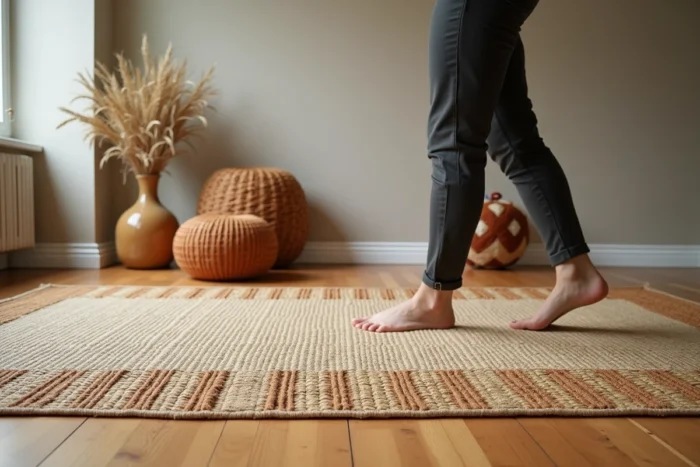
Sea grass, sisal, or jute provide an immediate organic touch. However, placing these materials on the wall (a trend seen on social media) poses maintenance and allergen issues in bedrooms. On the floor, a natural fiber rug is easier to clean and withstands daily foot traffic.
Avoid jute in humid rooms: it absorbs water and molds quickly. For the bathroom, a flat-woven cotton rug dries in a few hours and maintains a warm appearance.
6. Muted and contrasting colors rather than tone-on-tone
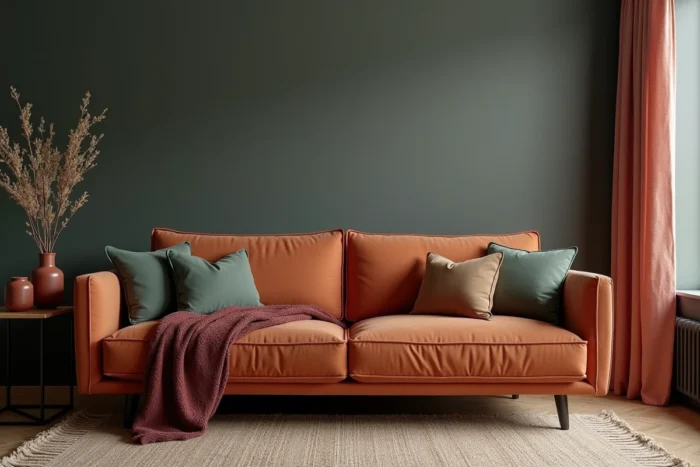
Monochrome beige-cream palettes dominate the cozy interiors presented online. The 2026 trends nuance this approach: chrome, amber glass, and bold patterns (including animal prints) reintroduce contrast without breaking the warmth.
An accent wall in a muted color creates more character than an entirely neutral room. Terracotta, sage green, and navy blue work as a backdrop for light textiles. The contrast draws the eye and structures the space.
7. Dense foliage plants to fill dead corners
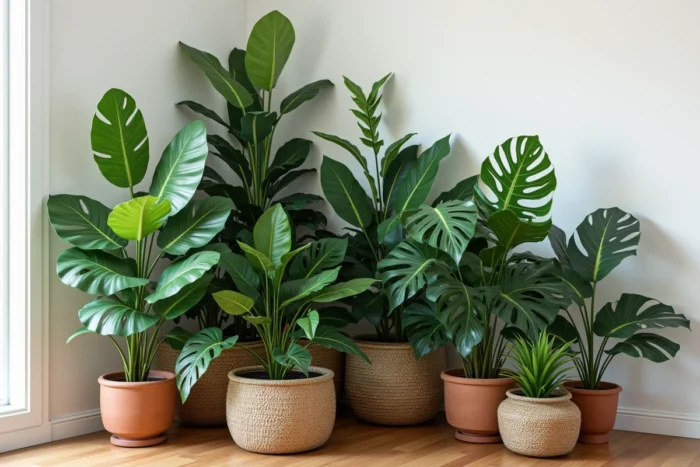
A tall plant (ficus, monstera) in an empty corner transforms an unused nook into a point of interest. Plants also help regulate indoor humidity, a comfort factor often underestimated.
The constraint: light. A corner far from the window is suitable for pothos or zamioculcas, but not for ficus, which needs strong indirect light. Choosing the plant based on the actual exposure of the location avoids frequent replacements.
8. Candles and diffusers positioned according to ventilation
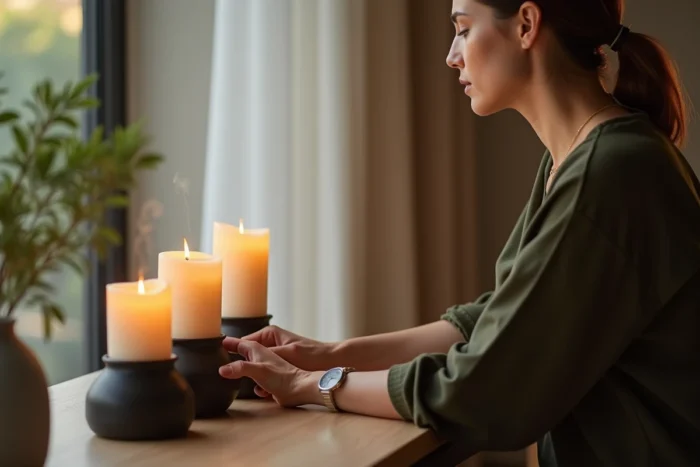
Amber glass candles are among the most sought-after decor items in 2026. Their warm light fully contributes to a cozy atmosphere. However, their olfactory effectiveness depends on placement.
Place them near a natural airflow (room entrance, near a ventilation outlet) so that the fragrance disperses without forcing the wick. A reed diffuser works better in a hallway or entryway than in a large open living room.
9. Closed storage to avoid visual overload
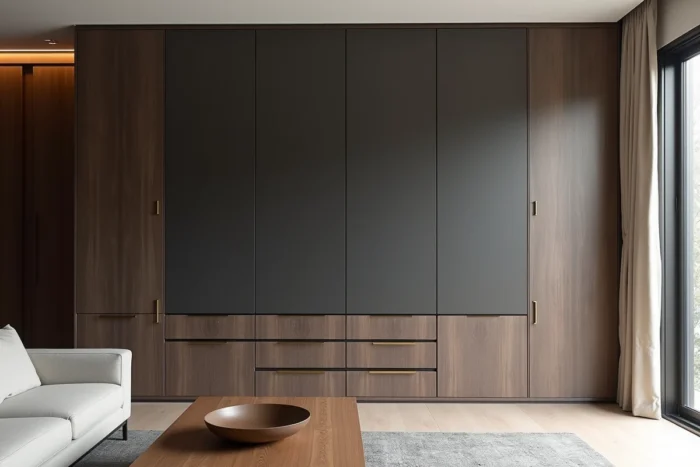
Visual clutter cancels the cocooning effect faster than any color choice. Open shelves filled with mismatched boxes create visual noise. A closed sideboard or woven baskets hide everyday items while remaining decorative.
In a bedroom, a headboard with integrated storage frees up the nightstand. Fewer visible objects lead to a greater perceived serenity.
10. Localized heating for targeted comfort

A warm cocoon does not rely solely on decoration. Real thermal comfort comes from heating suited to the use of each room. A wood stove or insert in the living room concentrates heat where the family spends time, without overheating the bedrooms.
Wood as a local heating energy combines thermal comfort and visual ambiance. The flame contributes to decoration as much as to heating. For homes without a flue, an inertia radiator made of stone or cast iron provides gentle and consistent warmth, much more pleasant than a blowing convection heater.
The most successful cocoon is one that takes into account the room as it is, not as we dream it in a catalog. Orientation, space, ventilation, insulation: these parameters determine which tips will work for you and which will remain decorative without providing tangible comfort.